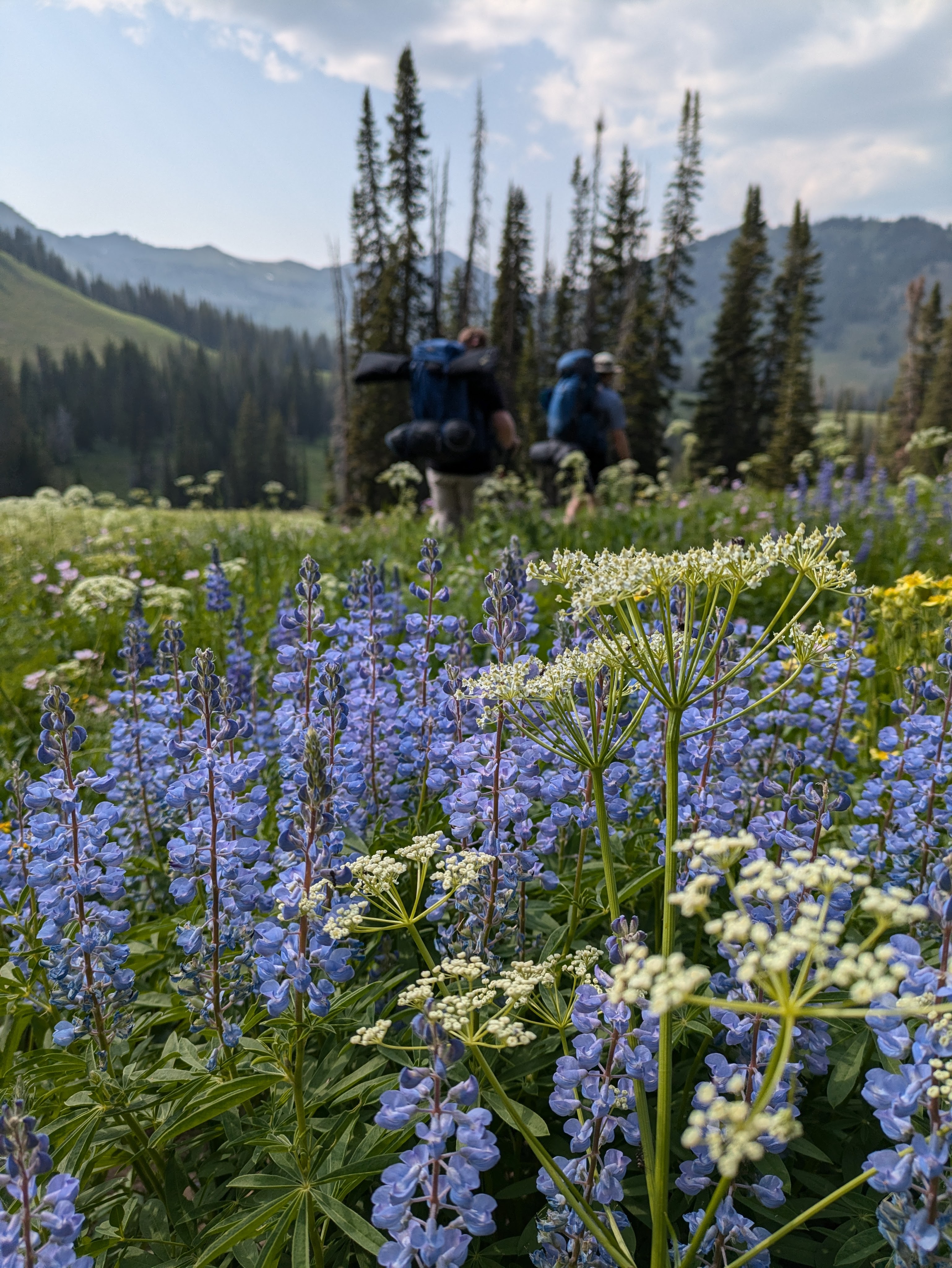
When I first heard about this trip to the Teton Crest Trail, I didn’t give much thought to where we were going. I knew I was going with a group of friends, that someone else had done the majority of the planning, and that all I had to do was show up with my plane tickets to the right airport on the right day. But as I stepped off of the Arial Tram onto Rendezvous Pass, I started grasping exactly how incredible this trail was going to be.
The Teton Crest Trail is nestled among the dramatic peaks of the Grand Teton Mountains, and wanders past glaciers, over creeks and rivers, past alpine ponds and wildflowers, and loops incredibly close to the Grand Teton itself. Due to the permits and camping “zone” setup, much of this trail is solitary. Have full-length conversations with the marmots if you want; there’s no one there to judge.

Five nights on the Teton Crest Trail

Starting trailhead: Teton Village
Day 1: Take the Arial Tram from Teton Village to the top of Rendezvous Pass; hike to Middle/South Fork. (3.5 miles)
Day 2: Hike to Alaska Basin (10.7 miles)
Day 3: Zero day at Alaska Basin! (0 miles, unless you do a day hike!)
Day 4: Hike to South Fork Cascade (7.3 miles)
Day 5: Hike to Leigh Lake (12.6 miles)
Day 6: Hike out to car (3.7 miles)
Ending trailhead: Leigh Lake Trailhead
All miles are calculated to group camp zones.
Trail overview
- Length: 40 miles
- Duration: 4-6 days depending on route and speed
- Peak Elevation: 10,695 feet
- Best Season to Hike: July through early September
- Difficulty Level: Moderate
- Beginner-friendly: Potentially; our group had beginners but I wouldn’t recommend it to beginners traveling without someone with experience
- Bear Canisters: Required in the Grand Teton National Park
- Permits: Required (see below)
Teton Crest Trail permits

To be able to camp on the Teton Crest Trail, you’ll need permits. There’s two ways to get these permits: online permits through Recreation.gov or walk-up permits at specific ranger stations in the Grand Teton National Park.
This trail is incredibly popular. Because of that, permits can be hard to get. Online permits through Recreation.gov are recommended; that way you’ll know your full itinerary and that there are spots for you.
Walk-up permits are available at the Jenny Lake Ranger Station or Craig Thomas Discovery & Visitors Center; however, there is no guarantee that there will be spots available, that these spots will be along your route, or that these spots will even make a coherent trip. If you decide to do walk-up permits, you’ll need to be flexible.
Permits for the Teton Crest Trail can be taken within minutes of going live. Here are a few tips to help you snag them!
- Know your itinerary ahead of time. Don’t try to figure things out as you’re reserving your permits.
- Be flexible with the dates. Pick a couple of different dates so that if one is already reserved, you immediately have a backup date.
- Have someone help you. If you need to adjust plans based on available permits or make on the fly adjustments, have someone there to help you make sure you’ve thought through everything correctly.
- Know where you do and don’t need a permit. Alaska Basin is outside of the Grand Teton National Park and therefore doesn’t require a permit. If you’re struggling to get permits inside the park, it can help to be creative with the wilderness areas surrounding it.
Gear for the Teton Crest Trail
The best tip? Always be prepared! Here’s my favorite backpacking checklist to help you make sure you have everything you need. Some of my favorite things on this trip were:
- Grand Teton National Park Map, by National Geographic Trails.
- Mountain Hardwear Ghost Whisperer 2 Hoody. Despite the fact that we went in July, the evenings could still get chilly!
- Dragonflies to scare away the mosquitos. Did it work perfectly? No. But did it help? Maybe. Did they look cute tied off on our backpacks and hats? Absolutely.
- Outdoor Research Echo Hoody Sunshirt. The sun was intense. This helped.
Grand Teton National Park
We landed our first morning in Salt Lake City. After making sure everyone had what they needed, we slipped into the rental cars and drove north towards the Grand Tetons.
This was my first time backpacking with such a large group. 12 of us had signed up for this adventure, with varying levels of experience. I’d done a lot of hiking along the Appalachian Trail and even a little bit in Utah, but I’d never done a trip with mountains rising this high before. Though Grand Teton towers a magnificent 13,775 feet, our highest point on the Teton Crest Trail would be Hurricane Pass at 10,338 feet.
There are multiple ways to begin your journey. One is by starting at Philips Pass Trailhead, and hiking up the mountain, a 2,500 foot climb from the valley to the crest. Our group opted not to do that. Instead, we took the Arial Tram to the top of Rendezvous Pass. There, where the tram deposits you, is a little cabin serving some of the best waffles you’ll eat.

We devoured the berry-coated, cream-topped waffles overlooking the wildflowers and the rising mountains. And when we licked the last of the syrup off our fingers, it was time to head out to our first campsite: The Middle South Fork group campsite.
The Tetons were waiting.
Alaska Basin
Somehow, our trip was planned perfectly. Though we crossed the occasional glacier or patch of snow, wildflowers bloomed all around us. Around each turn, a rainbow of alpine flowers stretched as far as one could see.

If you’ve never hiked in high altitude before, it’s important take this first day gently. Let your lungs learn how to respond to the new altitude. Keep track of how your body feels, and stay hydrated. If you need to rest, rest.
Above all, listen to your body and rely on the people around you. Speak up if you need to pause or rest. If weight needs to be shifted around between people, let your group know. By supporting one another, everyone can enjoy the beauty surrounding them.

Alaska Basin is located inside the Jedediah Smith Wilderness. As such, you don’t need a permit to camp there. After a sharp descent, you find tucked among the rocks a little oasis. Ponds, grass, creeks, flowers, trees, a shelf rising above you: all of this meets in the basin. We found the perfect pocket for our tents and made camp.
The next day, we took a planned zero day, or break day. Wandering around the ponds, we found a perfect spot to jump in and enjoy the cold water. One person packed along a small guitar; others played card games, some stretched out in the warmth of the sun. It made for the perfect spot to relax.

After our zero day, we packed up our campsite, said goodbye to our little spot among the ponds of Alaska Basin, and struck back out onto the trail.
Hurricane Pass
I find myself wanting to be beautiful when I write, that my words would be poetry and that as you read them, you would find in them a story and passion that resonates in your heart. And yet as I write, I can see the mountain rising before me and I have no words to describe it.
We came up over the pass, our group straggling out as each person found their own pace and settled into it. This entire trip, we’d been making an arch around the Tetons. Off in the distance you could see the tips of them here or there. Someone would point out a peak and ask, “Is that the Grand?” and someone else would squint and say, “why I believe so.”

And as we came to the top of Hurricane Pass, there they were, all three of them, rising up before us: the Tetons. This entire trip they had been so far away, tucked behind the other mountains in the Tetons range, and now they were there, they were real, reaching up in the sky before us. I was already higher up than I’d ever been in my life and still they were higher.
Hurricane Pass fell away below us into a valley. Schoolhouse Glacier sprawled across the wall, leading into a small pond. Snow still capped the Grand Teton, and we could trace the melting snow as it turned into waterfalls and rivers along the mountain’s side.

Inspiration Point
After experiencing the beauty and solitude of the Tetons, coming down will feel like a culture shock. Inspiration Point, accessible to many hikers and National Park enthusiasts via a ferry, is one of the most popular places to visit. A second favorite is Solitude Lake, leading many hikers to follow the trail up into the mountain range.
Our group decided to visit Inspiration Point, and so we diverted from the Teton Crest Trail for the last few miles, coming down to the overlook and taking the lake shore to Leigh Lake.
As the elevation dropped, the trees thickened and we started running into more and more day hikers. By the time we were a mile out from Inspiration Point, there was a steady presence of other people.

Inspiration Point itself was were we stopped for lunch that day. Chipmunks scrambled around the rocks, begging to be fed. People wandered across the rocks, admiring the view across the lake. After lunch, we followed the trail down to the lakeshore, following that past several small lake to our final camping destination. We even got stuck in a human traffic jam, as the line of people waiting for the shuttle ride back stretched past the dock and up the trail.
One last night on the Teton Crest Trail
It’s always a bittersweet night on the last night. You know the next morning that you’re going to pack up and hike out. The fresh air is going to fade away as the car takes you back into a city, to airport, to an airplane, to home. The mountains will shrink in the rearview mirror. The sunburn, sore muscles, and irreplaceable memories will be all that remain.
We made a fire that night, the crackling of wood as the background music to our laughter and storytelling. When the wood finally burned low, we slowly started drifting back to our tents, curling up in our sleeping bags, watching—this one last night—the Teton stars dance overhead.

The next morning, we got an extra treat. While some members of the group made the trek back to get the car left at Teton Village, the rest of us lounged around Leigh Lake. Despite the warm sun, the lake was still bitterly cold, being fed from the melting snowpacks on the mountains around it. The clear water was too inviting; we had no choice but to dive in.
Why you should hike the Teton Crest Trail
To sum up the trip in one word: glorious. The July weather was perfect. The little bits of snow were heavenly. The wildflowers were magnificent. The mosquitos were–well, they sucked.
If you’re looking for the backpacking trip of a lifetime, look no further than the Teton Crest trail.

Leave a Reply