Since Vermont, I’ve been sleeping in almost every morning. By sleeping in, I mean sleeping until about 5 am when we start sliding out of sleeping bags, rolling up mats, and packing up our gear for the day.
For the majority of the trail, I’ve been awake around 3-4 am, decidedly unable to sleep beyond that. But in these last two states, my body has needed the extra rest.
Mornings were when I did my blogging, tapping away at my phone screen as I listened to the snores and quiet shifting of my fellow hikers. So if you’ve been wondering about the recent lack of blog posts, don’t worry. Sparks has just been sleeping for the first time in her life.
Hiking through Vermont

Ah, Vermud.
We entered Vermont in a downpour. The doors of heaven opened and an angel started dumping buckets onto us. We trekked, head bent, feet sloshing, the trail turned into a river. As we went up a rock scramble just before the border, it felt like we were climbing a waterfall.
Turns out, it was just a foretaste. We got rained on nearly every day through Vermont.
Vermont is always muddy. That’s why the state’s nicknamed “Vermud,” after all. Walking through the mud each day was mentally hard. During the day, you could hit mud up to your shins. A couple times I was up past my knees. When this happens, the mud squelches down into your shoes and socks, water soaks into the leather of your boots, and you spend the remaining day squishing with each footstep. When your boot finally feels like it’s dried out a little bit, you slide on the next rock (or mistake a discoloring under the water as rock when it’s actually just a mud trap) and end up shin-deep in mud again.
This section tested my balance a lot. The majority of the trail involved hopping from rock to rolling log to slippery bog board and then back to stones to make it through the mud. But balance is a good thing; there are still plenty more mud and rocks to come.
Since it was raining constantly, nothing dried out either. The humidity was always high, holding the moisture onto everything. Each morning would find weary hikers, glaring at wet socks and boots, trying to find the motivation to put them on. Once they’re on, it’s fine, but boy is it hard to slip your warm feet into cold, wet socks every morning.

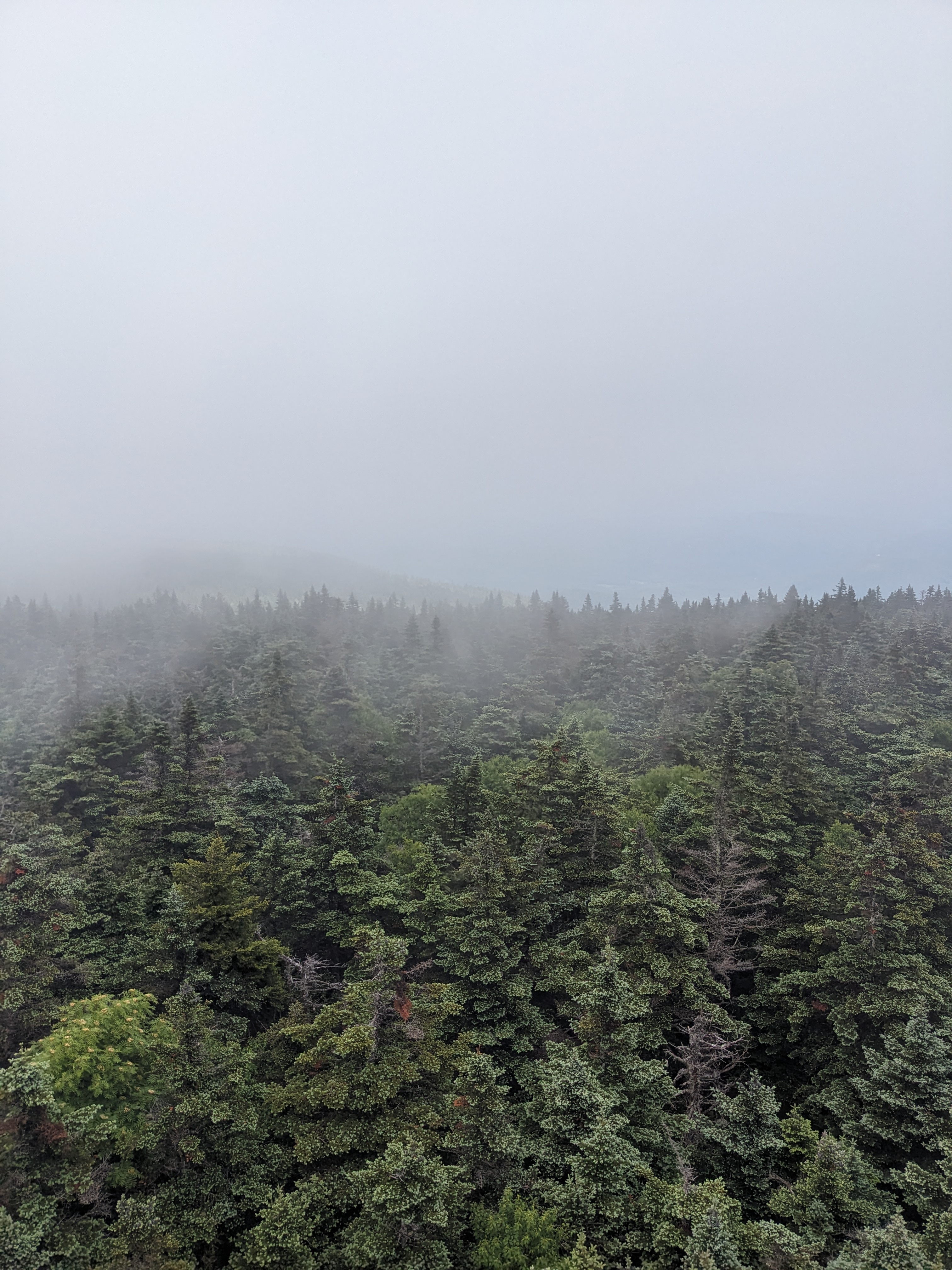
Despite the wet challenges of Vermont, it was an incredible state. From the moment we first stepped into the state, I was struck by how vivid everything was, how very alive the forest felt around me. Red pine trees shifting in the fog, ferns vibrantly green, dirt a rich brown. It was impossible to walk through the trail and not be in awe of the nature around me.
Vermont is the gateway to New Hampshire and Maine, the slow transition back to bigger mountains, and the steady walk towards where we’d be able to reach the tree line and alpine zones. For most of the trail, it’s easy to see the scenery mix with the state before it. We joke that perhaps we’ve never actually left Virginia; Virginia is simply eternal. But Vermont felt like stepping, fully, into a new section.
Vermont’s Long Trail

The first 105 miles of the Appalachian Trail in Vermont are placed on Vermont’s Long Trail, the first-long distance trail in America. The view from Stratton Mountain is supposed to be the view that inspired Benton MacKaye to create the Appalachian Trail.
But this section of the trail is special to me for another reason: It’s where I did my first solo backpacking trip. Though the majority of my three-day loop was off of the Long Trail, I still spent two influential nights in shelters we stayed in this trip. I love hiking areas I’ve already done, knowing what is coming and seeing for myself the growth I’ve had since the last time I was there.
At the Maine junction, we parted ways with the Long Trail. There are still 170 miles left of the Long Trail, which I’m told is full of rock scrambles, 4k mountains, peregrine falcons, and more Vermud. I have my eyes on it though… One of these days, even if it’s in small bites, I’ll finish it. Vermont is too good of a state to leave unfinished.
Church Mouse goes home

As we neared Rutland, Vermont, Church Mouse’s exhaustion was growing. She’d mentioned before that she was really worn out and lacked energy. We went through her pack, pulled out as much weight as she could live without and shipped it home. She felt like she was doing better, but as we reached Killington, our first 4,000 ft mountain since Virginia, it was clear that something was not right.
She took the train home from Rutland and was able to get a doctor visit. There she learned that, despite eating as much as she could on trail, she’d lost 10 percent of her body weight. Additionally, she’d developed a case of Bell’s Palsy, which is a condition that causes sudden weakness in the muscles on one side of the face.
She successfully finished her treatment for the Bell’s Palsy and is currently resting at home, recovering her strength.
Almost there
After Vermont, there are only two states left: New Hampshire and Maine. Reportedly the hardest states on the trail, they’re also the ones I’ve been most looking forward to. Katahdin, here I come.


Leave a Reply